AI for Essex Manufacturers: Practical Applications for the Shop Floor
Essex has the UK's second largest advanced manufacturing cluster. Here is how local manufacturers are using AI for quality control, maintenance, and order processing.
Essex is home to the second largest advanced manufacturing cluster in the UK: 4,205 businesses employing around 47,000 people and generating £2.16 billion in gross value added. The cluster is concentrated around Basildon and Braintree, where engineering employs over 7,000 people, and Harlow, which has particular strength in ICT, electronics, pharmaceuticals, and advanced manufacturing. Alongside the large names (Raytheon, Leonardo, Teledyne e2v, Ford) sits a much larger base of small and mid-sized manufacturers: precision engineering shops, food producers, plastics moulders, packaging firms, and contract manufacturers.
For these smaller manufacturers, AI is no longer a technology that only the large firms can afford. The costs have dropped, the tools have matured, and the applications that deliver the fastest payback are the ones that address problems every manufacturer recognises: quality defects, unplanned downtime, and time spent on paperwork.
Quality Inspection with Computer Vision
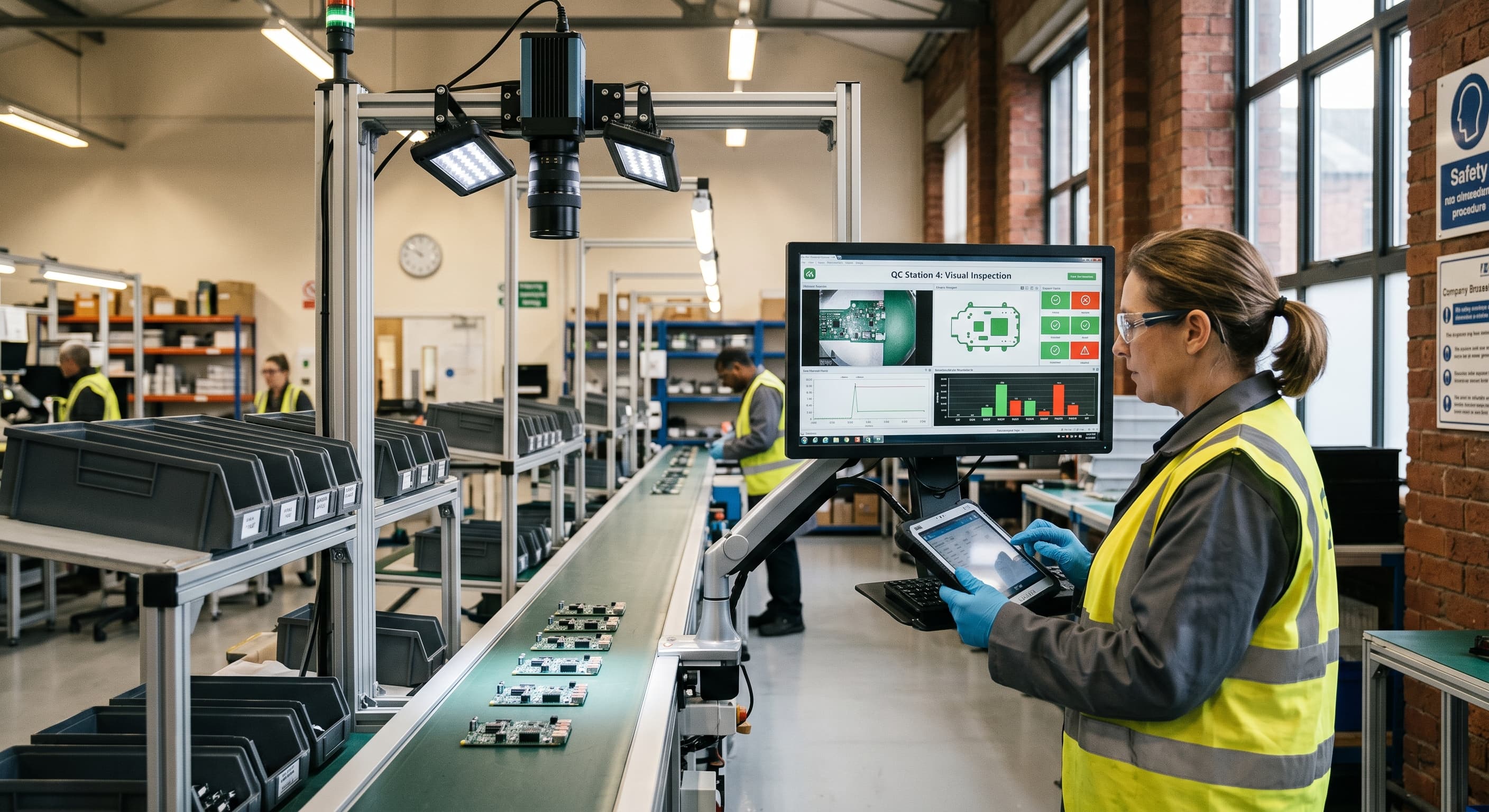
Visual inspection is one of the most straightforward AI applications in manufacturing. A camera mounted above a production line captures images of every item. An AI model, trained on examples of good and defective products, flags anything that does not match the expected standard.
For a small manufacturer running a single production line, an entry-level computer vision system costs between £2,500 and £8,000 for hardware (industrial camera, lighting, edge computing device) plus software. Installation and calibration typically adds 10 to 25% on top. Computer vision for quality control has delivered substantial reductions in defects and rework, though the headline figures usually come from large, enterprise-scale deployments. At SME scale the absolute savings are smaller, but the proportional impact on reject rates and rework can be comparable.
The practical benefit is consistency. Human inspectors fatigue, especially on repetitive tasks during long shifts. An AI system inspects every single item at the same standard, every time. For manufacturers supplying to sectors with strict quality requirements, such as automotive or aerospace sub-components, this consistency can be the difference between retaining and losing a contract.
Predictive Maintenance
Unplanned downtime costs UK manufacturers up to £736 million per week collectively. For a small manufacturer, a single machine failure during a production run can mean missed delivery dates, overtime costs, and damaged customer relationships.
Predictive maintenance uses sensors (vibration, temperature, acoustic) attached to critical machinery, combined with AI models that learn the normal operating patterns and flag when something is drifting towards failure. The principle is straightforward: fix the machine before it breaks, during a planned maintenance window, rather than after it stops the line.
McKinsey data shows predictive maintenance can reduce maintenance costs by 10 to 40%, cut downtime by up to 50%, and extend equipment lifespan by 20 to 40%. The Made Smarter programme found that grant recipients who adopted digital technologies including predictive maintenance achieved a 70% productivity increase, compared to 31% for those who received advisory support only.
At SME scale, the cost of a predictive maintenance deployment varies significantly depending on the number of machines monitored and the complexity of the installation. Software subscriptions range from £500 to £5,500 per year. The total implementation cost for a mid-sized manufacturer, including sensors, software, and integration, typically falls between £40,000 and £100,000, with a break-even period of 12 to 18 months. For a smaller operation monitoring fewer machines, costs can be proportionally lower, especially if the focus is on the two or three most critical pieces of equipment.
A practical caution: data quality determines success. Nearly half of manufacturers (47%) cite data fragmentation as a barrier to AI adoption. If your machines do not currently generate digital data, the first step is installing sensors and collecting baseline data, which adds time before the AI model can start making useful predictions.
Order Processing and Document Extraction
This is the application that delivers the fastest return for the least investment, and it does not require sensors or cameras.
Every manufacturer handles purchase orders, delivery notes, invoices, and specifications. In most SMEs, someone manually reads these documents, re-enters the data into an ERP or accounting system, and chases discrepancies. AI document extraction tools read the document (PDF, email, scanned image), pull out the relevant fields (order number, quantities, item codes, dates, prices), and feed them into your system automatically.
The error rate with manual data entry in document-heavy processes typically runs at 2 to 5%. AI extraction, once trained on your document formats, typically achieves 95% or higher accuracy, with the remaining exceptions flagged for human review. For a manufacturer processing 50 to 100 orders per week, the time saving is substantial: what took a full-time admin role can often be handled in a couple of hours of review.
MK Manufacturing in Colchester worked with AI Consultant Essex on exactly this kind of automation. They achieved a 90% reduction in processing errors and 60% faster order fulfilment. The investment paid back within months, not years.
Production Scheduling
For manufacturers running multiple product lines with varying batch sizes and changeover times, scheduling is a persistent headache. AI scheduling tools optimise the sequence of jobs to minimise changeover time, balance machine utilisation, and meet delivery dates.
This is a more complex application than document extraction and typically requires integration with existing ERP or production planning systems. The tools are maturing but tend to suit manufacturers with enough volume and variety to make optimisation worthwhile. A single-product operation running one shift may not see significant benefit. A contract manufacturer running 20 different jobs per week across five machines almost certainly will.
Funding Support: Made Smarter and Beyond
Essex manufacturers looking to adopt digital technologies, including AI, can access funding through the Made Smarter programme. The programme offers up to 50% match funding, with a maximum grant of £20,000, covering equipment, specialist advice, and training for industrial digital technologies. The Made Smarter South East pilot, running from April 2025 to March 2026, has received a £2.5 million funding boost.
Innovate UK Smart Grants provide a broader funding route, offering between £25,000 and £2 million for SME innovation projects. R&D tax credits also apply: if you are developing or adapting AI systems for your manufacturing processes, the qualifying expenditure may be eligible for tax relief.
The Ambitious Essex Growth Hub provides general business support including signposting to digital adoption programmes. While not AI-specific, it is a useful first point of contact for manufacturers who are unsure where to start.
Where to Start
The practical starting point for most small manufacturers is the application that requires the least infrastructure change and delivers the fastest visible result. In almost every case, that is document processing and order handling automation. It does not require sensors, cameras, or machine integration. It works with the paperwork you already have. And it frees up admin time that can be redirected to higher-value work.
Quality inspection with computer vision is the natural second step for manufacturers with a quality control bottleneck or high reject rates. Start with one production line, prove the value, then scale to others.
Predictive maintenance is the most technically demanding of the three and usually makes sense as a third step, once the business has some experience with AI tools and has digitised basic data collection from key machines. For a structured way to estimate the savings, try the free ROI calculator.
Getting Support
AI Consultant Essex works with manufacturers across the county, from the A12 corridor to Harlow and beyond. Our workflow automation projects start from £1,000 for straightforward document processing setups, with more complex manufacturing integrations scoped individually based on the number of systems involved and the level of customisation needed.
A free 20-minute consultation will help identify which application, whether it is document extraction, quality inspection, scheduling, or maintenance, will deliver the best return for your specific operation. We work with what you have: you do not need to rip out your existing systems to start seeing results from AI.
Frequently Asked Questions
How much does AI quality inspection cost for a small manufacturer?
An entry-level computer vision system costs between £2,500 and £8,000 for hardware and software, plus 10 to 25% for installation and calibration. Monthly software costs are typically included or run £50 to £200 per month.
Is there funding available for manufacturers adopting AI?
Yes. The Made Smarter programme offers up to 50% match funding with a maximum grant of £20,000 for digital technology adoption. Innovate UK Smart Grants provide £25,000 to £2 million for innovation projects. R&D tax credits may also apply.
Where should a small manufacturer start with AI?
Start with document processing and order handling automation. It requires no sensors or cameras, works with your existing paperwork, and typically delivers the fastest visible return. Quality inspection and predictive maintenance are natural second and third steps.
What results can manufacturers expect from AI?
Results vary by application. MK Manufacturing in Colchester achieved 90% error reduction and 60% faster order fulfilment through AI workflow automation. McKinsey data shows predictive maintenance can reduce maintenance costs by 10 to 40% and cut downtime by up to 50%.