AI for Essex Accountants and Professional Services Firms
How Essex accounting firms and professional services businesses are using AI to cut admin, speed up tax work, and free staff for advisory. Practical tools, costs, and compliance.
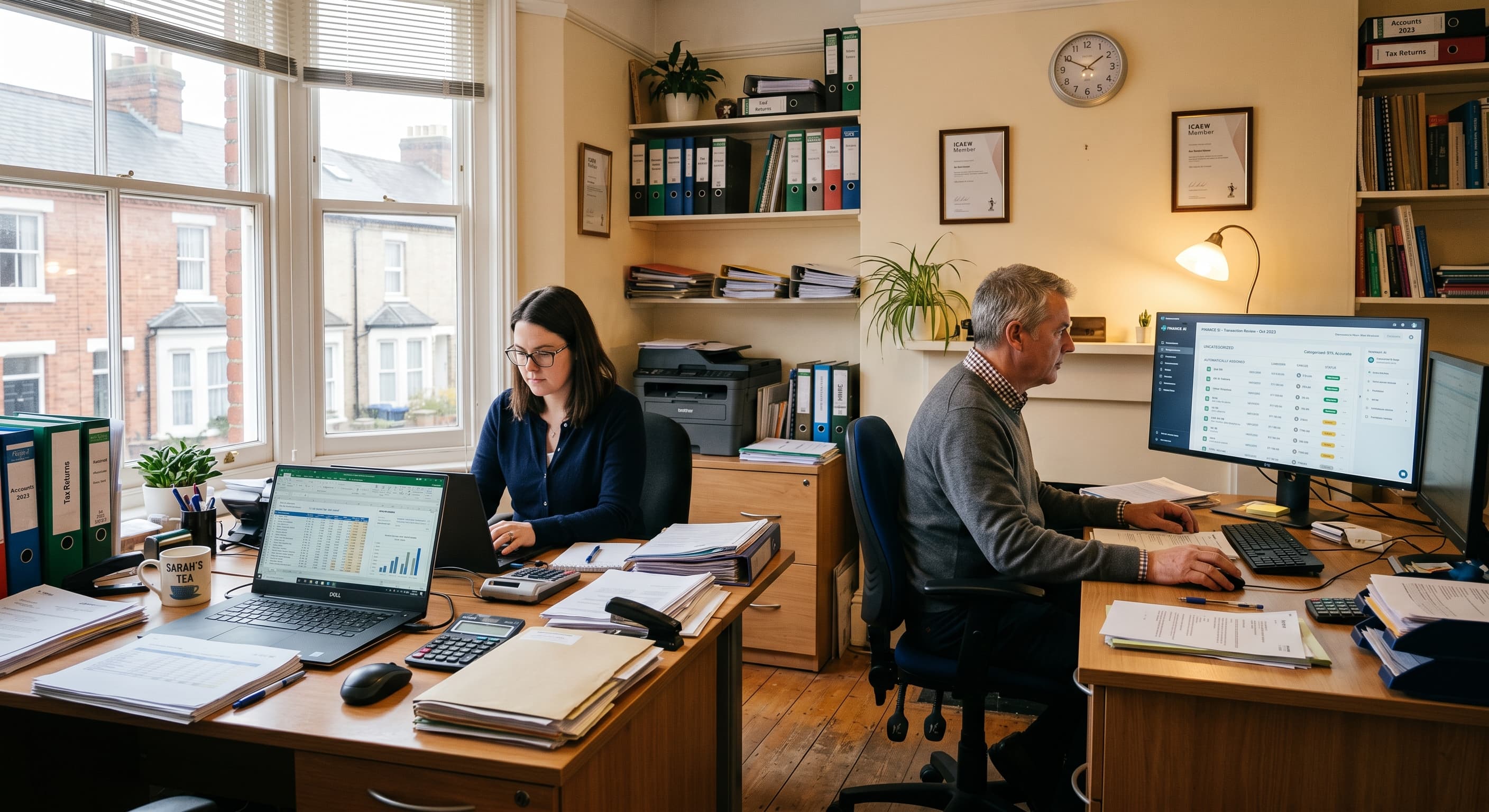
Most accounting firms in Essex still run on a cycle that has not changed much in 20 years: collect records from clients, enter data, reconcile, file returns, repeat. The difference in 2026 is that a growing share of that cycle can now be handled by AI tools that cost less per month than a single hour of a qualified accountant's time. This article covers what those tools actually do, what they cost, and what the professional bodies say about using them.
Where AI Fits in an Accounting Practice Today
The professional, scientific, and technical sector is the highest-adopting AI sector in the UK. A 2026 DSIT study found that 56% of businesses in this category reported using AI technologies, ahead of every other industry. Accounting sits at the centre of that shift because the work is structured, repetitive, and data-heavy: exactly the conditions where AI delivers measurable returns.
A 2024 ICAEW survey of 2,718 chartered accountants across 48 countries found that 83% of younger accountants (aged 18 to 24) already use AI weekly for data entry and productivity tasks. Among senior leaders, the picture is more cautious: only 47% said they were comfortable with AI, and 53% of C-suite executives felt unprepared to lead on it.
The gap between younger staff who are already using these tools and senior partners who are not creates a practical problem. Firms that do not engage with AI risk losing staff to competitors that do, while also missing productivity gains that are now well documented.
The Tools and What They Do
AI in accounting is not one product. It is a layer that sits across several stages of the workflow.
Receipt and invoice capture
Tools like Dext (formerly Receipt Bank) use OCR and machine learning to extract data from receipts, invoices, and bank statements. Dext's business tier costs around £25 to £30 per month for 250 documents and five users. For accountancy firms managing multiple clients, the practice tier runs at roughly £19 per client per month with a minimum of 10 clients. AutoEntry offers a similar service at comparable pricing. These tools handle the data entry that traditionally occupies junior staff for hours each week.
Bank reconciliation
Xero's AI features now auto-match transactions to invoices and suggest categorisations based on historical patterns. QuickBooks has introduced similar functionality. The accuracy is not perfect, but it typically handles 70 to 80% of routine transactions correctly on first pass, leaving staff to review exceptions rather than process everything manually.
Tax return preparation
AI does not prepare a tax return from scratch, but it accelerates the process. Tools like Intuit Assist flag anomalies, suggest allowable expenses based on client history, and pre-populate return fields. A sole practitioner who adopted Intuit Assist alongside FreeAgent reported automating 85% of data entry and tripling their client capacity within a year.
Client communication
AI-assisted email triage, meeting scheduling, and follow-up reminders reduce the admin burden around client management. This is less about specialist accounting tools and more about general AI productivity: scheduling tools, smart email drafting, and automated reminders when deadlines approach.
Practice management
Workflow routing, deadline tracking, and capacity planning can be partially automated. When a VAT return is due in 14 days and the client has not submitted their records, an automated reminder sequence saves the firm from chasing manually.
What the Numbers Say
Xero's November 2025 report found that UK accountants complete tasks 31% faster with AI, saving close to 19 hours per week per practice. Sage Copilot users reported saving 12 to 14 hours per week on average. Even accounting for some vendor optimism in those figures, the direction is clear.
At a practice level, those hours translate directly into capacity. A firm that recovers 15 hours per week can either take on more clients at the same headcount or redirect existing staff from compliance work into advisory services, which typically commands higher fees.
The Wolters Kluwer 2025 Future Ready Accountant report found that 91% of UK accountants planned to implement AI in 2025. Accountancy Age reported that nearly half of UK accounting firms were planning £50,000 to £100,000 in AI investment over the following 12 months. These are not small firms experimenting: this is the mainstream of the profession moving.
AI for Solicitors and Other Professional Services
The same principles apply to legal and other professional services firms, though adoption is earlier-stage.
Contract review.AI tools extract key clauses, flag unusual terms, and compare contracts against templates. For a small solicitor's practice handling commercial leases or employment contracts, this reduces first-pass review time significantly. The human solicitor still makes the judgement call, but the AI does the reading.
Client intake. Automated questionnaires that capture initial case details, conflict checks, and document requirements before the first meeting save admin time and ensure nothing is missed.
Document drafting. Generative AI assists with letters, reports, and standard legal correspondence. The output needs checking, but starting from a structured draft rather than a blank page is faster for most practitioners.
What the Regulators Say
ICAEW guidance. The ICAEW has published a Generative AI guide and runs an ongoing programme advising members on opportunities and risks. Their position is pragmatic: AI is a tool that chartered accountants should understand and use where appropriate, provided they maintain professional scepticism and verify AI outputs. They note that three in four businesses now rely on chartered accountants to ensure data integrity in an AI world, which positions the profession as essential, not threatened.
SRA position on legal services. The Solicitors Regulation Authority states that firms can use any technology appropriate for their business, subject to existing principles and standards. There is no specific SRA guidance yet on a duty of competence around AI, though the profession expects this to follow. In the meantime, firms must ensure AI use protects client confidentiality and legal privilege. Any information or document submitted to a court must be verified for accuracy, regardless of how it was produced.
Professional indemnity.Errors in financial reporting and tax advice remain top PI claims in accountancy. AI does not remove the professional's responsibility for the output. If a tool miscategorises an expense or misses an allowable deduction, the accountant is still liable. This is why every professional body emphasises human oversight: AI handles the volume, the professional handles the judgement.
Costs and Return on Investment
For a small to mid-sized Essex accounting practice, the entry cost is modest.
A Dext subscription at the practice tier costs roughly £190 per month for 10 clients, scaling with volume. Xero or QuickBooks subscriptions with AI features are already part of most firms' existing software spend. Adding AI-assisted workflow tools might add £50 to £200 per month depending on the platform.
Against that, recovering even 10 hours per week of staff time at a loaded cost of £20 to £30 per hour represents £800 to £1,200 per month in capacity freed. The payback is typically immediate: the tools cost less in their first month than the time they save.
The larger return comes from redeployment. A bookkeeper spending 25 hours per week on data entry who now spends 10 hours on data entry and 15 hours on client advisory work is generating higher-value output for the firm. Several UK practices have reported advisory revenue increases of 15 to 20% within six months of implementing AI across their compliance workflow. For a structured way to estimate the savings for your practice, try the free ROI calculator.
Where to Start
For an Essex accountancy or professional services firm that has not yet adopted AI tools, the practical starting point is straightforward.
Start with receipt and invoice capture. Dext or AutoEntry bolts onto existing accounting software (Xero, QuickBooks, Sage) with minimal setup. The immediate time saving is visible within the first week, which builds confidence for the next step.
Move to bank reconciliation AI. If the firm already uses Xero or QuickBooks, the AI reconciliation features are already included; they just need to be switched on and trained with a few weeks of confirmed matches.
Then look at client communication automation: scheduling, reminders, and deadline chasing. This does not require accounting-specific tools. General workflow automation tools like Make, Zapier, or Microsoft Power Automate can connect calendars, email, and practice management systems.
The common mistake is trying to automate everything at once. Pick the most time-consuming repetitive task, automate that, measure the result, then move to the next one. A phased approach costs less, disrupts less, and gives staff time to adapt.
Getting Help
AI Consultant Essex works with professional services firms across the county to identify which parts of their workflow will benefit most from AI, select the right tools, and implement them without disrupting client service. A typical engagement starts with a free 20-minute consultation to understand the firm's current processes and priorities. From there, training sessionsstart from £200 for individuals and £500 for teams, with full implementation projects scoped based on the firm's needs.
WP Partners Accountants in Basildon worked with us on AI workflow automation for their admin processes. If your firm is spending more time on data entry than on advising clients, that balance can be shifted.
Frequently Asked Questions
How much do AI tools cost for a small accounting practice?
Entry-level tools like Dext cost around £25 to £30 per month. Xero and QuickBooks AI features are included in existing subscriptions. A small practice can start seeing time savings for under £200 per month in total tool costs.
Will AI replace accountants?
AI automates repetitive tasks like data entry and bank reconciliation, but it does not replace the professional judgement that accountants provide. The ICAEW notes that three in four businesses rely on chartered accountants to ensure data integrity in an AI world.
Is it safe to use AI with client financial data?
Yes, provided you use business or API tiers of AI tools rather than free consumer versions. Business tiers contractually exclude your data from model training. Always check the provider's data processing terms and update your privacy notice.
How long does it take to see results from AI in an accounting practice?
Most practices see measurable time savings within the first week of implementing receipt capture tools like Dext. Broader workflow improvements typically show results within 30 to 60 days.